
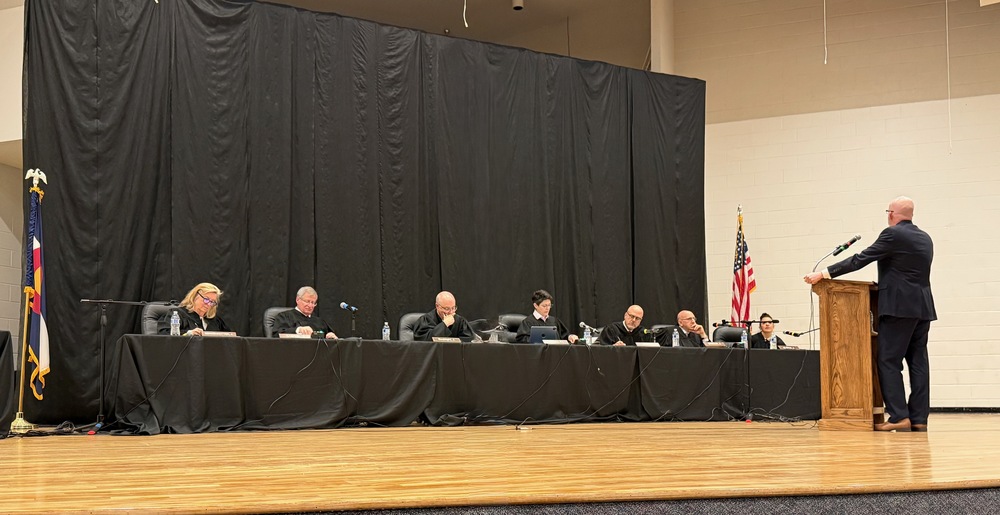
The Colorado Supreme Court heard oral arguments in two cases before an audience of high school students at Holyoke High School in Holyoke, Colorado, as part of the Colorado Judicial Department’s Courts in the Community outreach program on Thursday, April 16, 2026. Courts in the Community is an educational program that gives high school students a firsthand look at how the Colorado judicial system operates and how disputes are resolved in a democratic society.
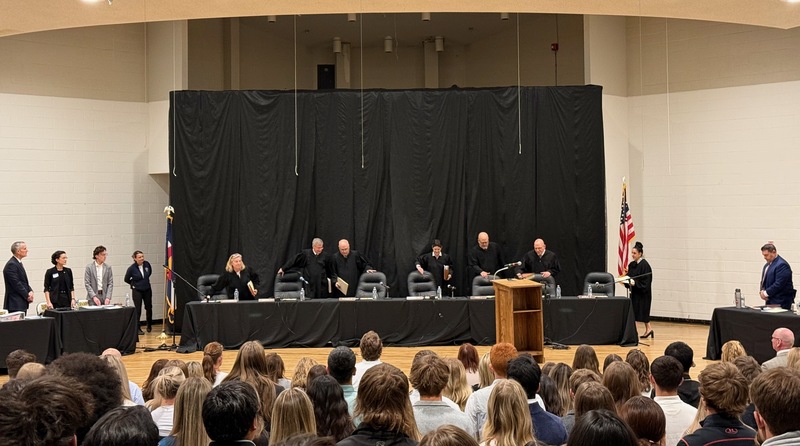
The seven justices of the Colorado Supreme Court — Chief Justice Monica M. Márquez; Justice Brian D. Boatright; Justice William W. Hood III; Justice Richard L. Gabriel; Justice Carlos A. Samour; Justice Maria E. Berkenkotter; and Justice Susan L. Blanco — were greeted by Holyoke High School students upon arrival. A light breakfast reception was held in their honor and was attended by members of the 13th Judicial District.
Using a curriculum designed for this outreach program, teachers from Holyoke High School and other schools in the 13th Judicial District prepared their students to hear the oral arguments in the weeks prior to the supreme court's arrival. The curriculum provided background information about the judicial system and about the cases that were presented.
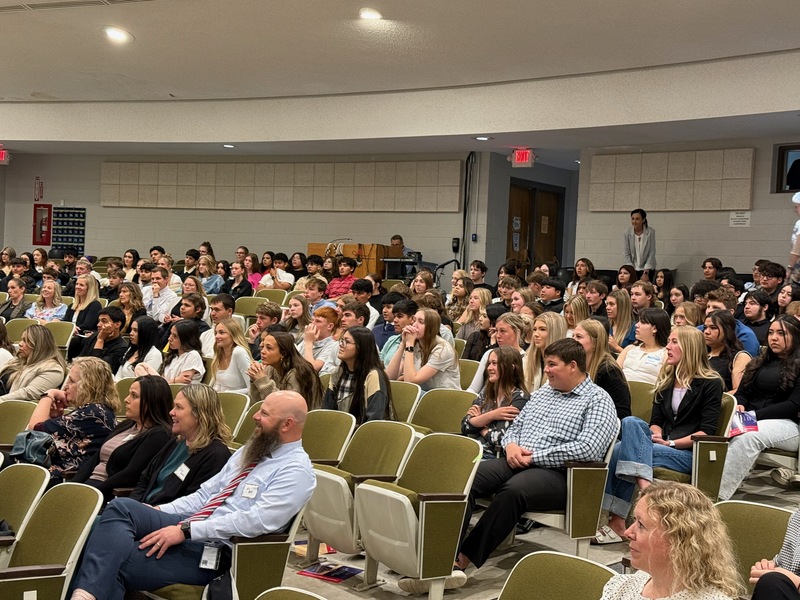
These were not mock proceedings. The court heard arguments in actual cases from which it will issue opinions. The court generally issues opinions within a month of the arguments. Students and other audience members were informed that Holyoke’s auditorium had become a courtroom for the morning and that they were expected to adhere to the decorum required of those who attend any court hearing.
The first case was Litterer v. Vail Summit Resorts, Inc. In this civil case, the plaintiff, while snowboarding at a ski resort, was injured when he collided with a snowmobile operated by a resort employee. The plaintiff sued the resort and its employee to recover for his injuries. While his lawsuit was pending, he bought a new ski pass from the resort; that pass contained a liability waiver that provided that he would “give up any and all claims” he currently had against the resort. The main question is whether this waiver operates to bar the plaintiff’s lawsuit for his prior accident. The plaintiff argues that the defendants have a statutory duty to operate snowmobiles safely and cannot use liability waivers to contract around that duty. The defendants argue that when the plaintiff bought the new ski pass and executed the liability waiver, he voluntarily agreed to relinquish his claims in the lawsuit in exchange for the right to use the resort’s facilities.
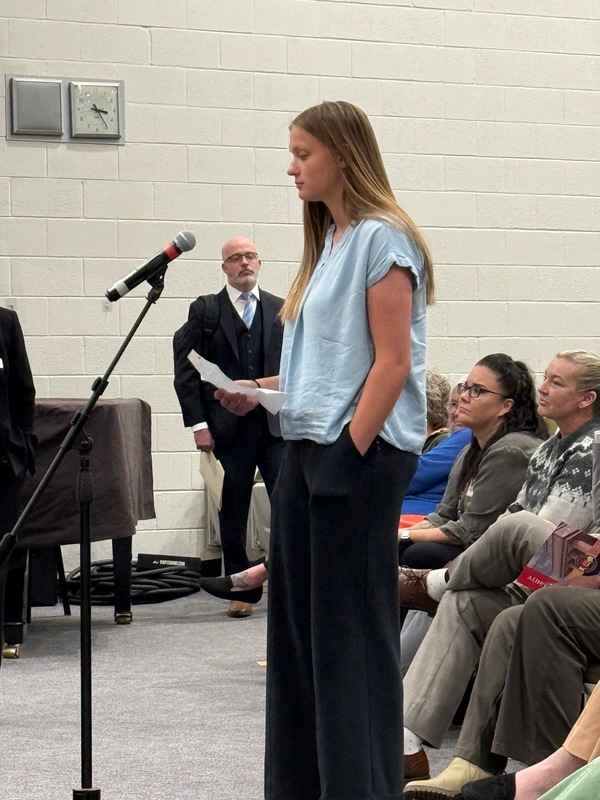
After the hearing, the court stood in recess. During the recess, students were given the opportunity to ask questions of the attorneys. Most student questions focused on the path to becoming a litigator and on advice the lawyers would give students wishing to pursue law as a career.
When the justices returned from recess, they began to hear arguments in the second case of the morning, Teran Sanchez v. People. In this criminal case, the defendant was convicted of certain offenses in county court after the trial court used a new model jury instruction explaining the concept of reasonable doubt. The jury instruction was a model criminal jury instruction introduced in 2023 by the Colorado Supreme Court’s Model Criminal Jury Instructions Committee. The instruction informed the jurors that they could convict the defendant if they were “firmly convinced” of the defendant’s guilt. The instruction also said that if the jurors believed that there was a “reasonable possibility” that the defendant was not guilty, they should acquit him. The defendant points out that the phrase “firmly convinced” is used in jury instructions to explain the lower burden of “clear and convincing evidence” in certain civil cases and therefore could not adequately explain “beyond a reasonable doubt.” He also argues that the “reasonable possibility” language suggests that he, as the defendant, has some obligation to put forward evidence from which the jury could find such a possibility. These implications, he says, mean that the jury could have convicted him on less than proof beyond a reasonable doubt and that he is therefore entitled to a new trial with a different instruction.
Upon completion of this case, the students once again were able to question the attorneys. This time the students' questions focused more on ethical issues behind the law. They received feedback about how lawyers deal with clients they may or may not agree with and how they choose their clients. Students learned that giving people time to cool off before acting is a good way to reduce the chance of rash decisions.
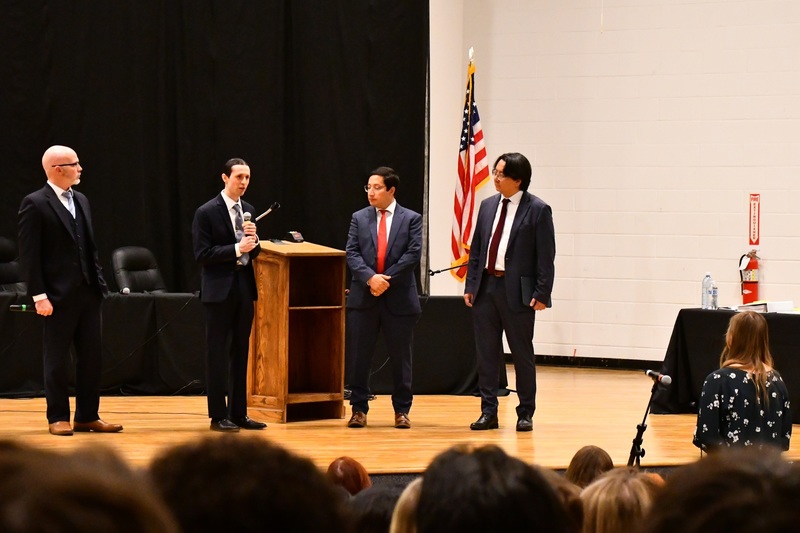
The justices returned to the stage and spoke to the students about their paths to the bench. One Holyoke student asked the justices if they could change anything, would they choose a different career. While each justice expressed strong satisfaction with their career arc, several mentioned other careers they might have chosen, including military service, astronaut, and head coach of the Denver Broncos, among others.
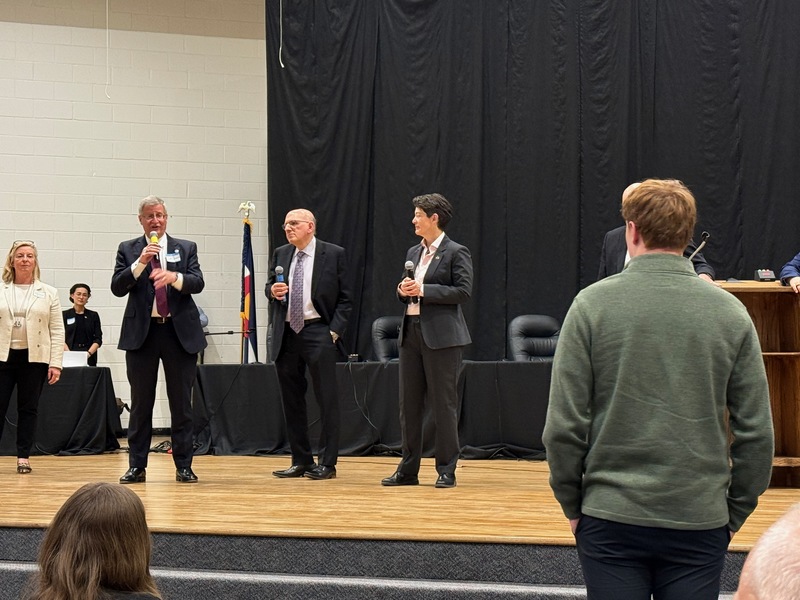
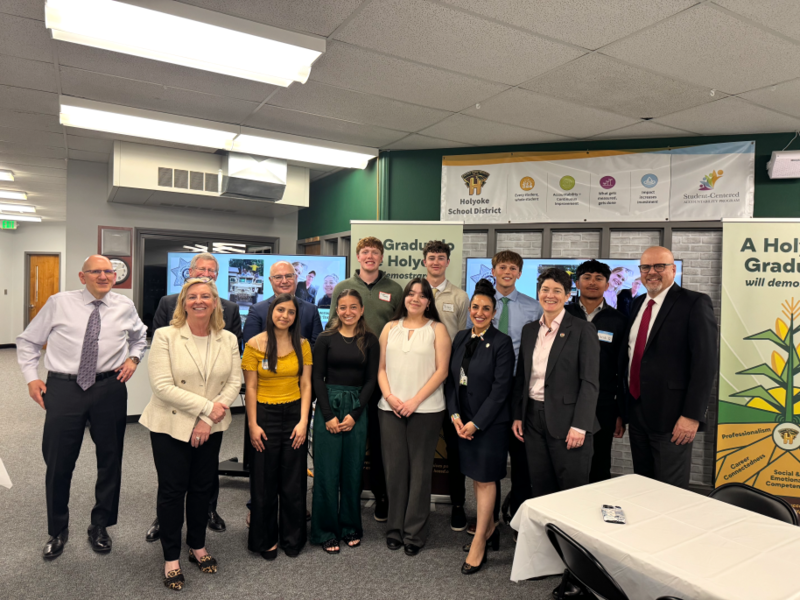
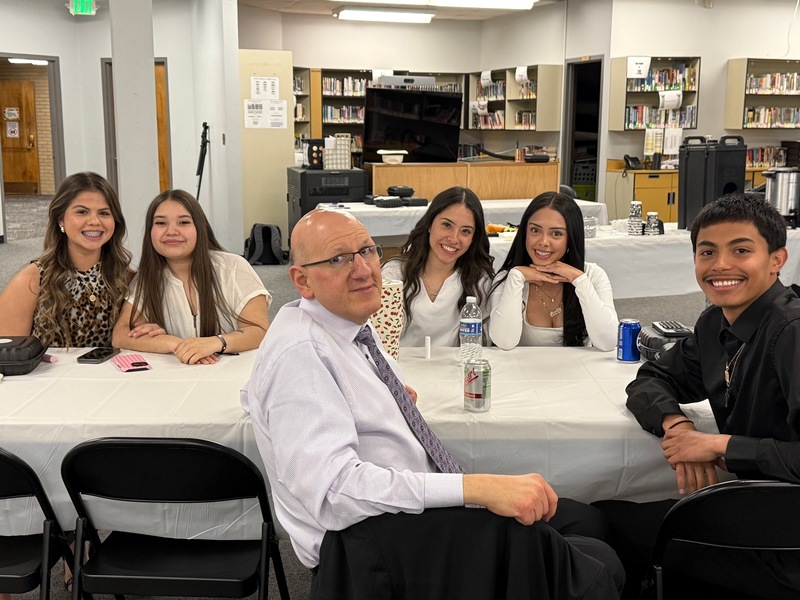
After the event in the auditorium, the justices and Holyoke Business Law and Government students had the opportunity to eat lunch together. Each justice sat at a different table, and the students and justices had an opportunity to connect personally.
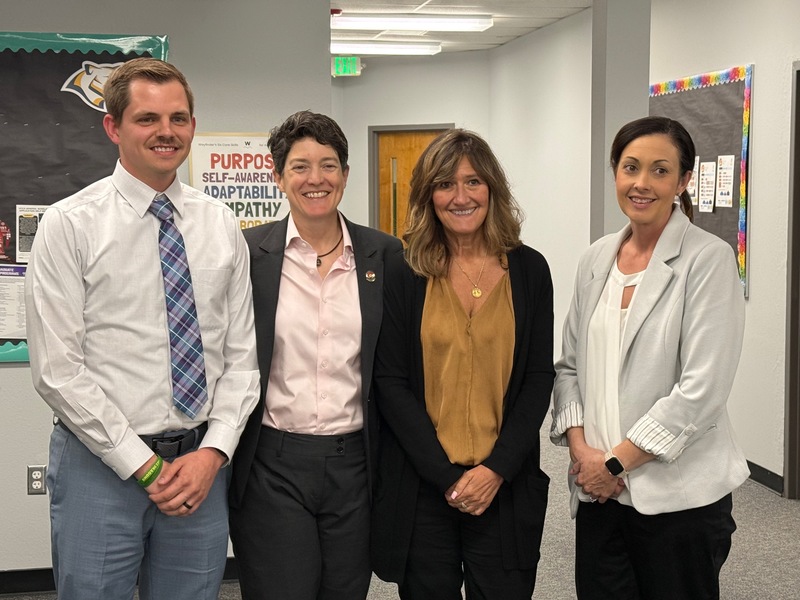
Chief Justice Márquez thanked the school, staff, and administration for being gracious hosts and presented court challenge coins to School Principal Angela Powell; Business Law teacher Lori Nelson; and Social Studies teachers Colby Stumpf and Megan Sprague.
The Colorado Supreme Court and Court of Appeals started the program on Law Day (May 1) in 1986 and it has run for the last 40 years. This was the Colorado Supreme Court’s first visit to Holyoke since the inception of the program.